
IK 737 Vindelev - C
IK No. adjusted: 737
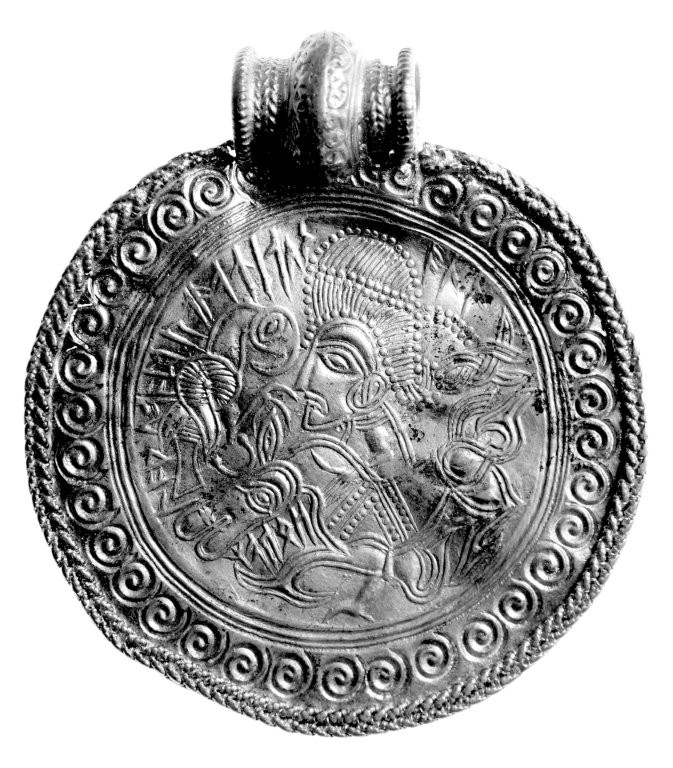
Material
gold
Condition
; Worn: No
Diameter
44 mm
Weight
15.6 g
Compass hole
No
Found year
2022
Museum
Vejle Museum
Registration No
x4, C 63588
Fake suspicious
No
Seriation group
:H2
Category of Inscription
runes
Inscription
Possible formular word
Inscription long
IK 737 [...] is almost identical to a bracteate from Funen IK 58, but differs in a few minor details. The inscriptions on IK 737 are placed in three or four different sections. One consists of three runes, running along the edge above the male head, another consists of five runes between the head and front leg of the horse, and a third consists of 16 individual characters running along the edge, behind the bird from the muzzle of the horse to the top of the hair of the male figure and vice versa. There are no separation marks. The writing direction of the runes indicates that they should probably be viewed as two or three different sequences or words. The four runes running from the muzzle of the horse are carved from the left to the right and transliterate to [I:] laþu. Rune 1: l. Rune 2: a. Rune 3: þ. The pocket of the rune stretches from just under the top of the main stave and almost reaches the bottom of the main stave. Rune 4: u. The main stave and the branch are of the same length and they are placed in a position, where both of them are leaning towards the middle. The rune is placed at some distance from rune 3. Rune 1: The rune resembles an s-rune with three joints. Rune 2: u. [II:] (s)u(l)i(t)a. The main stave and the branch are of the same length and they are placed in a position, where both of them are leaning towards the middle. Rune 3: Probably an l-rune with a lowered branch or an a-rune where the upper branch is missing. However, the inscription is so well preserved that the latter is less likely. Rune 4: i. Rune 5: Possibly a t-rune, where the branches of the rune are placed at some distance from the top, or possibly a mirrored l-rune, cf. the low branches on other l-runes on this bracteate. Rune 5: a. sequences and most of the runes point in either direction, except for the r-rune, as if the runes could be read from any direction. [III:] aarpaa. Rune 1: a, turning to the right. Rune 2: a, turning to the left. Rune 3: r, turning to the right. Rune 4: Probably p as in the Breza fu.ark inscription (SG-19). Less likely the rune could be read as a double e-rune as Heizmann 2001:332 or a d-rune as Düwel in Axboe et al. 1985:110. Rune 5: a, turning to the right. Rune 6: a, turning to the left. [IV:] a(l)(l). Rune 1: a. Rune 2: Probably l with the branch placed at some distance fromthe top of the main stave. Rune 3: The rune resembles an l-rune with the branch placed at some distance from the top of the main stave. The five runes between the horse’s head and front leg transliterate to: [V:] horaz. Rune 1: h. Rune 2: o. Rune 3: r. The pocket and branch are placed at some distance from the top of the main stave. The rune could be read as a u-rune, but the u-runes in other parts of the inscription have a distinctly different outline with two identical staves (see above). The rune in this sequence mostly resembles the r-rune in the sequence aarpaa and also has a weak hook where the supposed pocket and branch meet. Rune 4: a. Rune 5: z. (Originalzitate aus Imer/Vasshus, 2023, 64-70)